
English ·
Norsk bokmål ·
Polski ·
日本語 ·
简体中文 ·
Español
🎧 Listen to voice examples
# Hangry Labs VoxCPMTTS
Easy-to-run VoxCPM2 text-to-speech Docker images with Nano-vLLM inference, a browser UI, and an HTTP API included.
This Hangry Labs fork is made for local use without the usual Python environment, model download, and runtime setup work. Install Docker, run one command, open the browser interface, or connect an application to the local API.
## Quick Start
Choose one image and run it on the first visible NVIDIA GPU.
**Full image:** includes the pinned VoxCPM2 model assets and can run offline after the image pull.
```bash
docker run -d --name voxcpmtts --restart unless-stopped -p 127.0.0.1:8808:8808 --gpus all -e CUDA_VISIBLE_DEVICES=0 -v voxcpmtts_data:/app/persistent hangrylabs/voxcpmtts:v1.1@sha256:cc5a1f186cd8baeed3fe777b94ebe8a22648dbd30d5100a498bad46b860210a9
```
**Tiny image:** downloads the model into the persistent volume during first use.
```bash
docker run -d --name voxcpmtts --restart unless-stopped -p 127.0.0.1:8808:8808 --gpus all -e CUDA_VISIBLE_DEVICES=0 -e HF_HUB_OFFLINE=0 -e TRANSFORMERS_OFFLINE=0 -v voxcpmtts_data:/app/persistent hangrylabs/voxcpmtts:v1.1_tiny@sha256:ca0b5ca41289a931238410d2fcb7c7b8462ed71d4e0a69d8cb6b8cbb17ac2fe6
```
Then open **[http://localhost:8808](http://localhost:8808)**. Interactive API documentation is available at **[http://localhost:8808/tts/docs](http://localhost:8808/tts/docs)**.
Need a different operating system, registry, GPU, or network-access command? Use the [VoxCPMTTS installation command picker](https://hangrylabs.app/software/voxcpmtts/install?os=windows&hardware=nvidia&image=full®istry=dockerhub&access=computer).
The `voxcpmtts_data` volume preserves model caches, saved voices, dialogue scripts, reference audio, and application state across container replacement. Full and tiny images can reuse the same volume. To select another physical GPU, change `CUDA_VISIBLE_DEVICES`; keep one VoxCPMTTS model-serving container per GPU.
## What You Get
- A browser UI for voice design, voice cloning, transcript-guided cloning, local reference transcription, and optional non-destructive voice or generated-audio finishing
- Persistent saved voices and dialogue scripts with restorable recipes, portraits, search, SSML-H import/export, and reuse across sessions
- SSML and SSML-H documents for timed narration, multi-speaker discussions, and plays
- An OpenAI-compatible speech API plus the complete native API for applications and local integrations
- Opt-in compact and advanced Streamable HTTP MCP endpoints with expiring audio links
- Multilingual generation across 30 VoxCPM2 languages
- WAV, MP3, FLAC, OGG, Opus, AAC, and raw PCM output
- Nano-vLLM inference with CUDA graph acceleration
- Default-on long-form protection that splits near natural boundaries, with an explicit opt-out
- A baked image containing the model assets required for offline inference
- A smaller image for persistent Hugging Face cache workflows
- Python 3.13 and binary-wheel-only Docker builds
**Languages:** VoxCPM2 officially supports [30 languages and nine Chinese dialect groups](SUPPORTED_LANGUAGES.md).
> [!TIP]
> **Hear it before installing:** Open the [interactive 30-language examples gallery](https://hangry-labs.github.io/VoxCPMTTS/examples/) for voice design, cloning, and a featured Magic dialogue.
Official images are published to [Docker Hub](https://hub.docker.com/r/hangrylabs/voxcpmtts/tags) and [GitHub Container Registry](https://github.com/Hangry-Labs/VoxCPMTTS/pkgs/container/voxcpmtts).
> [!IMPORTANT]
> The project-owned and upstream-derived source is Apache-2.0, but the Docker images are aggregate distributions containing model assets, NVIDIA CUDA libraries, FFmpeg, and other packages under their respective terms. Read [Third-Party Notices](THIRD_PARTY_NOTICES.md) before deployment or redistribution.
Product page: [hangrylabs.app/software/voxcpmtts](https://hangrylabs.app/software/voxcpmtts).
### Build complete dialogue scripts
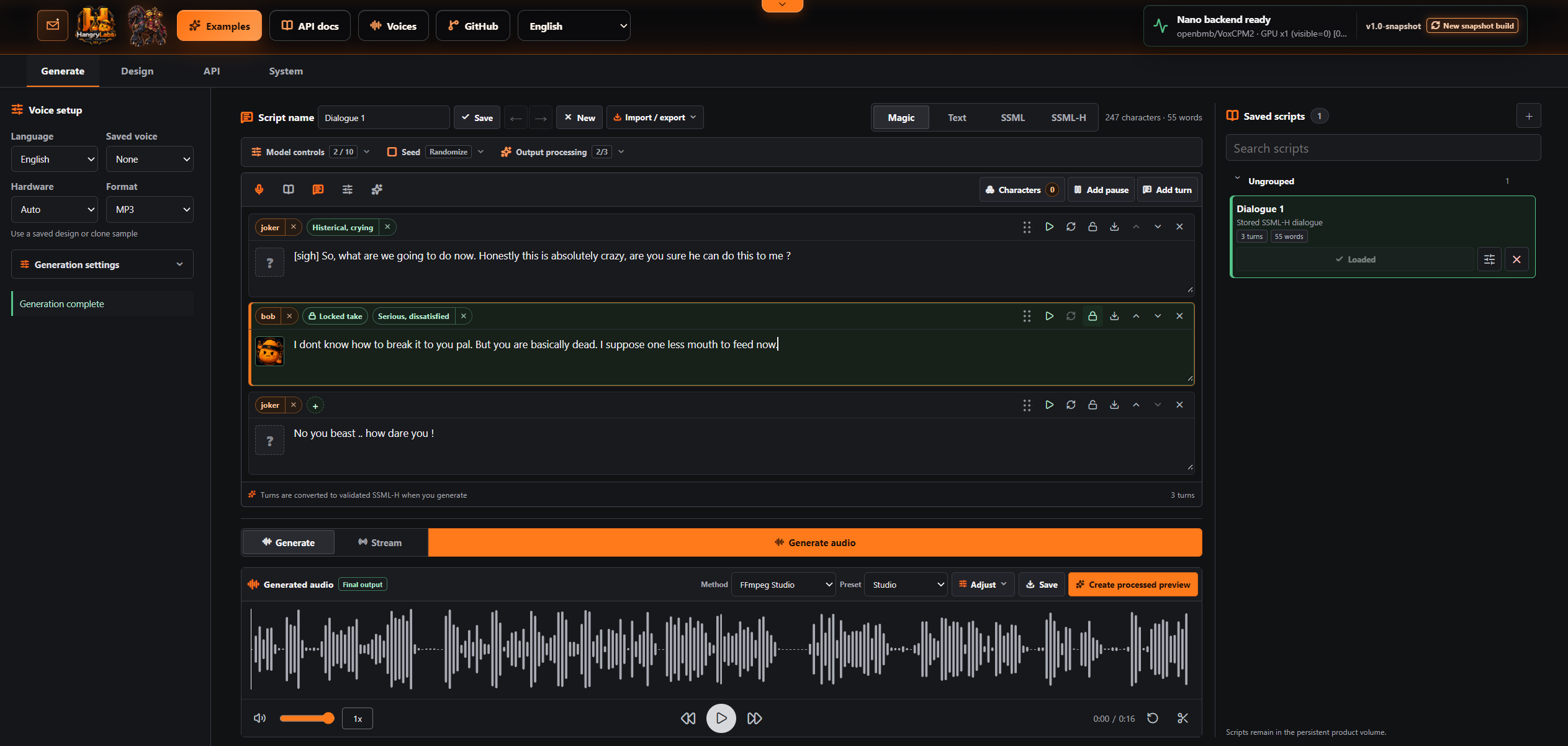
Use the Magic editor to assemble multi-speaker scenes visually, assign saved or script-defined voices, control each turn's language, rate, pitch, volume, direction, and loudness leveling, mark pronunciation ranges, generate and lock individual takes, rearrange speech and pauses without rerendering accepted audio, download any turn, and save the complete dialogue as portable SSML-H.
### Design, clone, and reuse voices
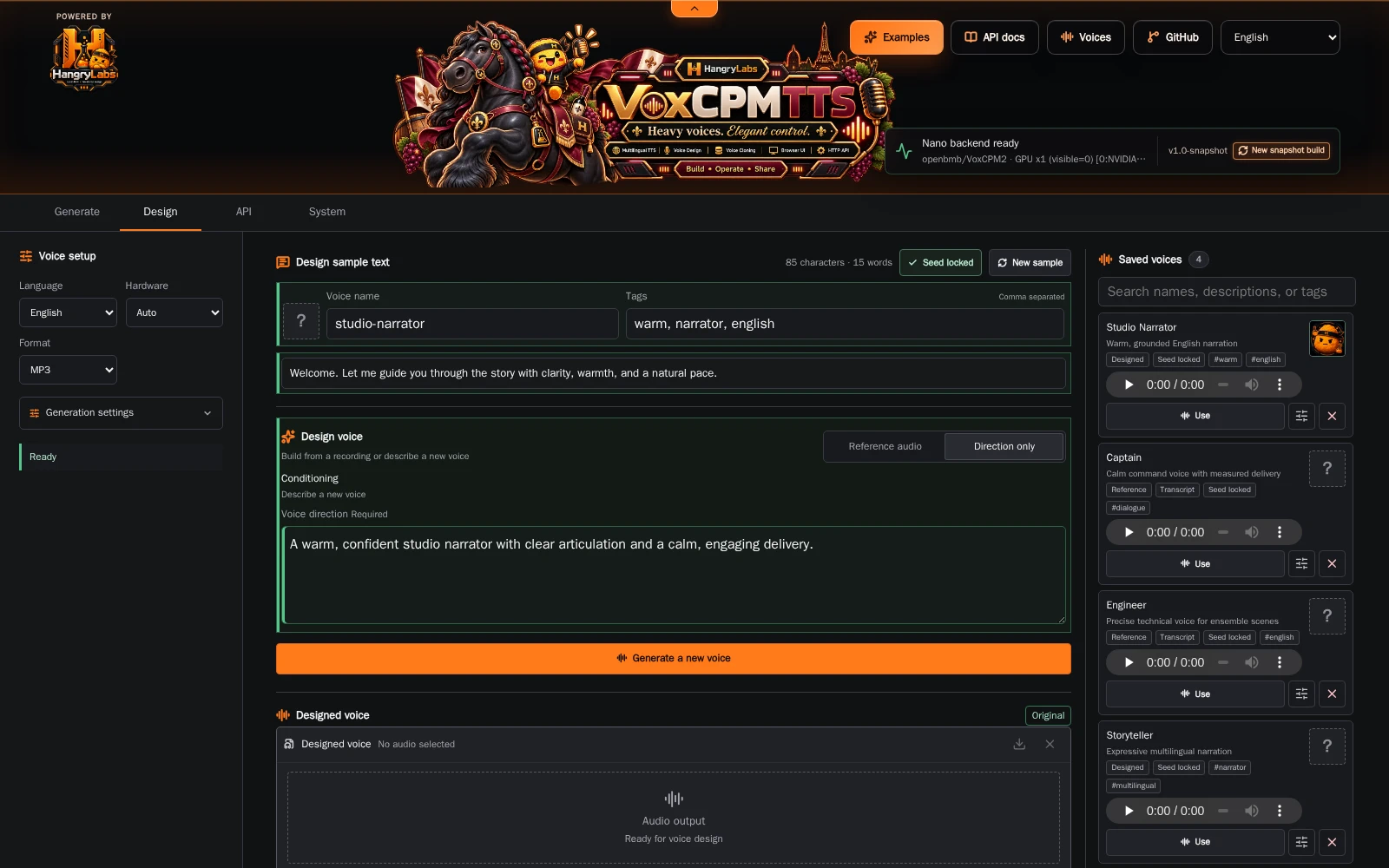
Create voices from natural-language direction or reference recordings, lock seeds for consistency, attach portraits and tags, refine the audio, and reuse saved characters across future scripts.
## MCP
VoxCPMTTS provides two opt-in Streamable HTTP MCP endpoints on the existing application port. Open **System > MCP access** to enable either endpoint; the choices are stored in the persistent product volume and take effect immediately without restarting the container.
- `http://localhost:8808/mcp/` is the recommended compact endpoint. Its five tools cover health, language search, saved-voice discovery, speech inspection, and simple MP3 generation. `talk_simple` requires only `text`; language, voice, and link TTL are optional.
- `http://localhost:8808/mcp/advanced/` includes the compact tools plus SSML/SSML-H generation, one-off reference cloning, voice design, and persistent saved-voice creation or deletion.
Both endpoints are disabled by default and have no separate application authentication. Enable them only for trusted clients or behind an authenticated reverse proxy. Advanced mutation tools must be used only when the caller intends to change persistent voices.
Generation returns metadata and an expiring capability URL rather than embedding audio or base64 in protocol context. The default TTL is one hour and callers can request 60 to 86,400 seconds. Another local service, including speech recognition, can fetch that URL before expiry. Generated files live under `/app/persistent/mcp-output` and are removed after expiry; advanced local-reference tools accept files only from `/app/persistent/mcp-input` or bounded HTTP(S) URLs.
When the client or downstream service connects through another host, set `VOXCPM_MCP_BASE_URL` to the externally reachable origin so returned links are usable from that network. Replace `voxcpm.example.com` below with your server's reachable hostname:
```bash
docker run -d --name voxcpmtts --restart unless-stopped -p 8808:8808 --gpus all -e CUDA_VISIBLE_DEVICES=0 -e VOXCPM_ENABLE_MCP=1 -e VOXCPM_MCP_BASE_URL=http://voxcpm.example.com:8808 -v voxcpmtts_data:/app/persistent hangrylabs/voxcpmtts:v1.1@sha256:cc5a1f186cd8baeed3fe777b94ebe8a22648dbd30d5100a498bad46b860210a9
```
The environment switches are startup defaults. Values saved in the System tab take precedence afterward. `task mcp-live-test` verifies both catalogs, calls `talk_simple`, follows its temporary URL, and validates the downloaded MP3.
## Docker Reference
Image tags, persistence, GPU memory, and runtime tuning
### Image Tags
- `latest` - rolling full snapshot from `main`
- `latest_tiny` - rolling tiny snapshot from `main`
- `vX.Y` or `vX.Y.Z` - immutable full release
- `vX.Y_tiny` or `vX.Y.Z_tiny` - immutable tiny release
Snapshot or development version tags are intentionally not published. Release tags are created only when the project is ready for a release. Full and tiny tags are mirrored between Docker Hub and GHCR.
For reproducible deployment, use the complete Docker Hub reference published in the relevant [Version History](#version-history) section:
```text
hangrylabs/voxcpmtts:vX.Y@sha256:
```
The immutable digest is authoritative if a readable tag is ever changed. Rolling `latest` tags intentionally remain unpinned because they represent the current snapshot.
### Runtime Profile
The standard runtime uses Nano-vLLM, Python 3.13, CUDA 12.8, and a prebuilt FlashAttention wheel. Triton still performs normal first-use kernel JIT compilation inside the container; Python packages and wheels are not compiled during the image build.
The default `VOXCPM_NANO_GPU_MEMORY_UTILIZATION=auto` targets an approximately 8 GiB Nano-vLLM process budget while adapting the fraction to installed VRAM: about `0.67` on a 12 GiB GPU and `0.50` on a 16 GiB GPU, capped at `0.90` on smaller cards. Set an explicit fraction in the range `(0, 1]` only when tuning for other workloads. The service canonicalizes `auto` and `cuda:0` to one cached model instance and defaults to concurrency one.
For throughput-oriented API workloads, set `VOXCPM_NANO_MAX_NUM_SEQS=2` to schedule two requests against the same loaded model. This raises aggregate throughput without loading a second copy of the weights, but increases individual request latency and fixed-seed output can vary with concurrent batch composition. Keep the default of `1` when exact seed repeatability matters.
At concurrency one, the service accepts up to eight waiting inference calls in a bounded FIFO (`VOXCPM_NANO_QUEUE_SIZE`) while preparing request data and finishing completed audio on CPU. Only one worker enters Nano-vLLM, so queued requests do not add another model copy or change seed ordering. Set `VOXCPM_NANO_QUEUE_SIZE=0` to disable FIFO admission and retain the original semaphore path when optimizing exclusively for one-at-a-time request latency. Encoded reference conditioning is reused from a content-addressed CPU-memory LRU cache, bounded by `VOXCPM_NANO_LATENT_CACHE_ENTRIES=32` and `VOXCPM_NANO_LATENT_CACHE_BYTES=268435456`; set either cache limit to `0` to disable it. Queue state is available from `/tts/activity` and `/tts/status`.
The fixed `v1.0` image predates automatic sizing and uses `0.49`. On a 12 GiB GPU, set `VOXCPM_NANO_GPU_MEMORY_UTILIZATION=0.67` in `docker run` or Compose; older images may incorrectly suggest lowering this value when the calculated budget is already negative.
CUDA graphs are enabled by default. Set `VOXCPM_NANO_ENFORCE_EAGER=1` only for troubleshooting. `TORCHINDUCTOR_COMPILE_THREADS=1` prevents unused compile-worker pools from retaining RAM, and the image releases temporary CUDA allocator blocks after reference-audio encoding so different reference lengths do not accumulate VRAM high-water allocations.
Nano-vLLM fixes the diffusion step count when the engine starts. The image default is 10; set `VOXCPM_NANO_INFERENCE_TIMESTEPS` before startup when another value is required, then send the same `inference_timesteps` value in API requests.
Reference transcription lazy-loads the pinned multilingual `openai/whisper-base` model on CPU, preserving GPU memory for VoxCPM2. The full image bakes the 282 MiB ASR snapshot for offline use; the tiny image stores it in the mounted Hugging Face cache after the first transcription. Set `VOXCPM_LOAD_ASR=0` to disable transcription, or override `VOXCPM_ASR_DEVICE` and the pinned model settings when maintaining a custom image.
## API Usage
OpenAI-compatible and native HTTP API examples
### OpenAI-compatible speech
Point an OpenAI client at `http://localhost:8808/v1` or call the standard speech route directly:
```bash
curl -X POST "http://localhost:8808/v1/audio/speech" \
-H "Content-Type: application/json" \
-d '{"model":"tts-1","input":"Hello from Hangry Labs VoxCPMTTS.","voice":"alloy","response_format":"mp3"}' \
-o hello.mp3
```
The official Python client works by changing only its base URL:
```python
from pathlib import Path
from openai import OpenAI
client = OpenAI(base_url="http://localhost:8808/v1", api_key="local")
with client.audio.speech.with_streaming_response.create(
model="gpt-4o-mini-tts",
voice="coral",
input="This request uses the OpenAI speech interface.",
instructions="Warm, clear, and conversational.",
response_format="mp3",
) as response:
response.stream_to_file(Path("speech.mp3"))
```
Supported model aliases include `tts-1`, `tts-1-hd`, `gpt-4o-mini-tts`, `voxcpm2`, and `openbmb/VoxCPM2`. Standard voice names map to stable VoxCPM voice designs with fixed seeds, while any saved VoxCPMTTS voice profile can be passed as `voice`. Discover them through `GET /v1/audio/voices`; model discovery is available at `GET /v1/models`.
The standard `instructions`, `speed`, and `response_format` fields are supported. Output formats are `mp3`, `opus`, `aac`, `flac`, `wav`, and raw 24 kHz `pcm`. VoxCPMTTS extensions include `voice_profile`, `language`, `seed`, `randomize_seed`, `normalize_text`, `normalize_loudness`, `protect_long_audio`, `cfg_value`, `inference_timesteps`, `device`, `denoise`, `ref_audio`, `ref_text`, and `clone_mode`. Binary audio responses are supported; `stream_format: "sse"` is rejected explicitly because speech-event streaming is not implemented. Use the native endpoints for progressive model-chunk streaming, uploads, SSML, and SSML-H.
Authentication is optional for local use. Set `VOXCPMTTS_API_KEY` on the container to require `Authorization: Bearer ` on `/v1` routes. The placeholder `api_key="local"` above is accepted when server-side authentication is not configured.
### Native API
Default native generation returns WAV:
```bash
curl -X POST "http://localhost:8808/tts/generate" \
-H "Content-Type: application/json" \
-d '{"text":"Hello from Hangry Labs VoxCPMTTS.","language":"English"}' \
-o hello.wav
```
Request MP3 when compact output is preferred:
```bash
curl -X POST "http://localhost:8808/tts/generate" \
-H "Content-Type: application/json" \
-d '{"text":"Hello from Hangry Labs VoxCPMTTS.","language":"English","output_format":"mp3"}' \
-o hello.mp3
```
Voice design:
```bash
curl -X POST "http://localhost:8808/tts/generate" \
-H "Content-Type: application/json" \
-d '{"text":"This is a designed voice.","control":"young female, warm and gentle","output_format":"mp3"}' \
-o designed.mp3
```
Mount a reference directory when using container-local cloning paths:
```bash
docker run --name voxcpmtts --restart unless-stopped -p 8808:8808 --gpus all -e CUDA_VISIBLE_DEVICES=0 -v "$(pwd)/samples:/data:ro" -v voxcpmtts_data:/app/persistent hangrylabs/voxcpmtts:v1.1@sha256:cc5a1f186cd8baeed3fe777b94ebe8a22648dbd30d5100a498bad46b860210a9
```
```bash
curl -X POST "http://localhost:8808/tts/generate" \
-H "Content-Type: application/json" \
-d '{"text":"This voice follows the reference sample.","ref_audio":"/data/ref.wav","output_format":"mp3"}' \
-o cloned.mp3
```
Provide `ref_text` to use transcript-guided cloning:
```bash
curl -X POST "http://localhost:8808/tts/generate" \
-H "Content-Type: application/json" \
-d '{"text":"The model continues from the reference voice.","ref_audio":"/data/ref.wav","ref_text":"Transcript of the reference audio.","output_format":"mp3"}' \
-o guided.mp3
```
Clone conditioning is explicit when an application needs predictable behavior. Use `clone_mode: "reference"` with `control` to direct delivery from the reference audio, or use `clone_mode: "transcript"` with the exact `ref_text` spoken in that audio. The browser Design workspace supports those two reference modes as well as direction-only voice creation. Reference uploads accept WAV, MP3, FLAC, OGG, Opus, M4A, AAC, and WebM audio. Its compact pipeline keeps sample text to one line, provides immediate seed locking, and records the voice name, portrait, and searchable tags before generation. Missing portraits use a clickable placeholder; uploads are stored as lossless 100x100 WebP images. After generation, the original remains playable and an optional finishing stage can create a separate Clean, Studio, or custom preview. FFmpeg Studio provides bounded noise cleanup, bass, presence, dynamics, and loudness controls; Signalsmith Voice adds independent pitch and speed shaping before the same mastering pass. The user compares both versions and explicitly chooses which reference to save. **Store voice** retains the selected reference, matching words, original design input, and validated processing recipe. Editing restores the complete pipeline, locks the existing name, and moves the active voice to the top of the library. **Update details** changes tags or the portrait without touching audio or recipe data, while **Update voice** requires a fresh generation and named replacement confirmation.
Post-process an audio file independently without loading VoxCPM2:
```bash
curl -X POST "http://localhost:8808/tts/postprocess-upload" \
-F "audio=@designed.wav" \
-F 'options={"method":"ffmpeg","preset":"studio","noise_reduction_db":2,"bass_db":1,"presence_db":1,"dynamics":35,"normalize_loudness":true}' \
-o designed-studio.wav
```
Use Signalsmith Voice for independent pitch and speed shaping before the same mastering pass:
```bash
curl -X POST "http://localhost:8808/tts/postprocess-upload" \
-F "audio=@designed.wav" \
-F 'options={"method":"signalsmith","preset":"custom","pitch_semitones":-2,"speed_factor":0.95,"noise_reduction_db":2,"bass_db":1,"presence_db":1,"dynamics":35,"normalize_loudness":true}' \
-o designed-shaped.wav
```
The endpoint returns mono 48 kHz float WAV. Pitch is bounded to +/-6 semitones, speed to 0.75x-1.25x, all inputs are range-validated, and the source upload is removed after processing.
Transcribe an uploaded or browser-recorded reference locally before cloning:
```bash
curl -X POST "http://localhost:8808/tts/transcribe-upload" \
-F "reference_audio=@reference.mp3" \
-F "language=auto"
```
SSML and SSML-H are explicit input modes. Saved clone names can be selected with ``; SSML-H can also design request-scoped speakers for complete discussions, publish them to the voice library with `scope="profile"`, and apply a free-form delivery direction to an individual turn with `h:direction`:
```bash
curl -X POST "http://localhost:8808/tts/generate" \
-H "Content-Type: application/json" \
-d '{"input_type":"ssml-h","output_format":"mp3","text":"A thoughtful guest with a relaxed delivery.Welcome to the show.Thank you. It is good to be here."}' \
-o discussion.mp3
```
Use `input_type: "ssml"` for standard SSML without Hangry Labs voice definitions or free-form directions. Use the supported standard `` controls for portable rate, pitch, and volume changes; natural-language turn direction is intentionally namespaced as `h:direction` and requires `input_type: "ssml-h"`. Capabilities and limits are available from `GET /tts/ssml/capabilities`. Markup is never inferred when `input_type` is omitted.
Progressive MP3 streaming begins returning encoded model chunks before synthesis finishes:
```bash
curl --no-buffer -X POST "http://localhost:8808/tts/stream" \
-H "Content-Type: application/json" \
-d '{"text":"This audio is generated and played progressively.","stream_format":"mp3"}' \
-o streamed.mp3
```
Set `normalize_loudness` to `true` to apply output-level normalization toward `-16 LUFS` with a `-1.5 dBTP` true-peak ceiling. It runs once, after complete text, SSML, or Magic assembly, and is also supported by progressive MP3 streaming. Reference audio, generated Magic takes, and denoising stay unnormalized. Text preprocessing remains the separate `normalize` option.
Long-form protection is enabled by default for native and OpenAI-compatible requests. It keeps the same seed and conditioning while dividing long text near complete sentence or clause boundaries, then joins sections with a short natural pause. Set `protect_long_audio` to `false` only when one uninterrupted model pass is explicitly required.
For repeatable output, set `randomize_seed` to `false` and provide a 32-bit `seed`. Every generated response reports the seed actually used in `X-VoxCPM-Seed`.
Cheap process health check:
```bash
curl http://localhost:8808/tts/ping
```
Runtime discovery is available from the local API:
- OpenAI-compatible models: `GET /v1/models`
- OpenAI-compatible voices and saved profiles: `GET /v1/audio/voices`
- OpenAI-compatible speech synthesis: `POST /v1/audio/speech`
- Status and loaded backend: `GET /tts/status`
- Current generation stage: `GET /tts/activity`
- Saved voices: `GET` and `POST /tts/voice-profiles`; `PUT` and `DELETE /tts/voice-profiles/{name}`
- Saved dialogue scripts: `GET` and `POST /tts/dialogue-scripts`; `GET`, `PUT`, and `DELETE /tts/dialogue-scripts/{name}`; downloadable SSML-H at `GET /tts/dialogue-scripts/{name}/download`
- SSML and SSML-H capabilities: `GET /tts/ssml/capabilities`
- Lazy local reference transcription with the baked multilingual Whisper Base model: `POST /tts/transcribe-upload`
- Generated-audio alignment when `/tts/status` reports it available: `POST /tts/timestamps-upload`
- Optional FFmpeg voice finishing without model inference: `POST /tts/postprocess-upload`
- Supported languages: `GET /tts/languages`
- Output formats: `GET /tts/formats`
- Interactive API reference: `GET /tts/docs`
- Compact MCP: `/mcp/`; advanced MCP: `/mcp/advanced/`; persistent controls: `GET /system/settings` and `PUT /system/settings/mcp`
## Benchmarks
Baseline results and repeatable benchmark commands
The checked-in [benchmark suite](benchmarks/BENCHMARKS.md) measures warmed generation speed, GPU and container memory, transcript fidelity, and multi-turn SSML reliability through a fixed Qwen3-ASR comparative judge. Native and Nano backends run sequentially on one GPU with concurrency one, and raw per-call results are retained for regression tracking.
The initial baseline covered 24 common languages and 312 measured calls per backend on an NVIDIA GeForce RTX 5070 Ti:
| Signal | Native | Nano |
|---|---:|---:|
| Median real-time factor | 1.134 | 0.271 |
| p95 real-time factor | 1.272 | 0.315 |
| Mean transcript similarity | 95.90% | 96.36% |
| Exact transcript rate | 46.15% | 46.79% |
| Peak VRAM delta | 7,849 MiB | 8,491 MiB |
| Peak container RAM | 10,836.0 MiB | 3,376.5 MiB |
Nano was **4.19x faster** by median real-time factor without an aggregate transcript-fidelity regression. It used 642 MiB more peak VRAM in this configuration while reducing peak container RAM by 7,459.5 MiB. Speech recognition is a consistent semantic comparison, not a replacement for listening tests.
Run the complete suite manually with:
```bash
task benchmark-build
task benchmark-baseline -- --asr-url http://127.0.0.1:8000 --comment "description of the change"
task benchmark-ssml -- --asr-url http://127.0.0.1:8000 --comment "description of the change"
```
Benchmarks are intentionally excluded from normal tests, image builds, and releases.
## Local Development
Docker-first development, testing, and release commands
This repository is validated primarily through Docker:
```bash
task --list
task doctor
task compile
task image-tiny
task test
task image
task imagerun
task smoke
```
`task image-tiny` prepares the test/runtime base, and `task test` runs the checked-in suite in an ephemeral CPU-only container based on that image. `task image` builds the full baked image. `task imagerun` runs it without an external model-cache mount so the image proves its baked assets. `task imagerun-tiny` covers the online first-use cache workflow. `task smoke` checks natural speech, two designed voices, and reference cloning against the running API; add `-- --asr-url http://qwen3-asr-host:8010` to judge transcript fidelity. All Docker dependency installs require binary wheels.
`task mcp-test` runs deterministic MCP schema, transport, artifact-expiry, and guarded remote-input checks inside the image. With a deployment running, `task mcp-live-test` enables both tiers and verifies real linked-audio generation.
Hot-swap local package code into the selected image without rebuilding:
```bash
task localrun
task localrun-tiny
task logs
```
Preview and prepare a release from a clean `main` branch:
```bash
task release DRY_RUN=1
task release
```
The release task requires a snapshot `VERSION` such as `1.0-snapshot`, validates the tiny image, checked-in tests, and full baked image, creates the local release commit and annotated `vX.Y` tag, and prepares the next minor snapshot commit. After review and push, GitHub Actions publishes matching full and tiny tags to Docker Hub and GHCR. Creating the public GitHub Release and recording Docker Hub's top-level OCI digests in the release notes remain deliberate post-publish steps.
## Upstream Project
VoxCPM2 is developed by OpenBMB and contributors.
- Original repository: [OpenBMB/VoxCPM](https://github.com/OpenBMB/VoxCPM)
- Model: [openbmb/VoxCPM2](https://huggingface.co/openbmb/VoxCPM2)
- Technical report: [VoxCPM2 Technical Report (arXiv:2606.06928)](https://arxiv.org/abs/2606.06928)
- Documentation: [voxcpm.readthedocs.io](https://voxcpm.readthedocs.io/)
- Nano-vLLM runtime: [a710128/nanovllm-voxcpm](https://github.com/a710128/nanovllm-voxcpm)
This runtime-focused fork intentionally removes upstream training and data-preparation workflows. Use the original project for model training and research reproduction.
## About This Fork
This is an independently maintained Hangry Labs packaging and serving fork of VoxCPM by OpenBMB, ModelBest, THUHCSI, and contributors. The upstream model and research are the core contribution. Hangry Labs maintains the Docker packaging, browser UI, HTTP API, examples, benchmarks, release tooling, and runtime documentation in this distribution.
Source licensing and attribution are recorded in [LICENSE](LICENSE) and [NOTICE](NOTICE). Model, dependency, and image-runtime terms are documented in [Third-Party Notices](THIRD_PARTY_NOTICES.md).
## Support And Issues
- Open a [GitHub issue](https://github.com/Hangry-Labs/VoxCPMTTS/issues) with the Docker command, image tag, GPU, logs, and reproduction steps.
- Check the [upstream VoxCPM project](https://github.com/OpenBMB/VoxCPM) when the issue concerns model behavior rather than this packaging and serving layer.
## Version History
v1.2 snapshot and v1.1/v1.0 release notes
Snapshot commands intentionally follow the rolling `latest` tags. Published-release commands retain their readable version tag and pin Docker Hub's immutable top-level OCI digest; that digest is authoritative if a tag is ever changed.
### v1.2 Snapshot
- Add a multilingual README-based project website with shared navigation, an
integrated listening gallery, local gallery styles and accessible motion controls.
- Improve optional text normalization to preserve literal comparisons and arithmetic,
clean prose Markdown and recognized HTML without reading their formatting aloud,
and avoid whitespace-related normalization errors. Chinese greater-than symbols
receive the same spoken-symbol handling as less-than symbols.
- Return a failing CLI exit status for incomplete batches while continuing remaining
entries and retaining successful audio files, so scripts can detect generation or
required output-writing failures. Optional timestamp warnings remain non-fatal.
- Correct prefixed Chinese word tokenization consistently in Nano inference and
generation-length estimates, matching the character-splitting policy bundled
with the pinned VoxCPM2 tokenizer. [Qualification results](benchmarks/chinese_tokenization/DETAILS.md)
cover targeted Chinese fixes and unchanged output across 312 multilingual calls.
- Update optional native image handling to Pillow 13, remove unused Spaces/Gradio
dependencies, and slim the local website builder to its pinned renderer/plugins
without remote-theme ZIP extraction. The qualified Nano inference stack is
unchanged.
The current development snapshot is published through the rolling tags from `main`:
**Full image**
```bash
docker run --name voxcpmtts --restart unless-stopped -p 8808:8808 --gpus all -e CUDA_VISIBLE_DEVICES=0 -v voxcpmtts_data:/app/persistent hangrylabs/voxcpmtts:latest
```
**Tiny image**
```bash
docker run --name voxcpmtts-tiny --restart unless-stopped -p 8808:8808 --gpus all -e CUDA_VISIBLE_DEVICES=0 -e HF_HUB_OFFLINE=0 -e TRANSFORMERS_OFFLINE=0 -v voxcpmtts_data:/app/persistent hangrylabs/voxcpmtts:latest_tiny
```
### v1.1
Release changes:
- Added independently gated compact and advanced Streamable HTTP MCP endpoints, persistent System controls, saved-voice discovery and management, guarded local and remote reference inputs, and expiring generated-audio URLs suitable for other local services.
- Replaced the fixed Nano-vLLM memory percentage with an automatic approximately 8 GiB budget, allowing 12 GiB cards to receive the same practical engine budget qualified on 16 GiB hardware while preserving explicit operator overrides.
- Updated Nano-vLLM-VoxCPM from 2.0.4 to 2.0.5 and carried its merged PR 89 block-cache fix while awaiting the next upstream release. The controlled synchronization benchmark found established performance parity and byte-identical output across all 312 paired calls; see the [full report](benchmarks/nano_upstream_sync/DETAILS.md).
- Added opt-in Nano scheduler concurrency through `VOXCPM_NANO_MAX_NUM_SEQS`, allowing two requests to share one loaded model for throughput-oriented API workloads while retaining concurrency one as the deterministic default.
- Added a configurable bounded FIFO at concurrency one, request-scoped queue progress, aggregate status telemetry, explicit HTTP 429 overload handling, and a bounded content-addressed cache for reference-conditioning latents. The FIFO is operationally safer but performance-neutral versus the previous semaphore; concurrent submission itself improves aggregate throughput. The [queue report](benchmarks/inference_queue/BENCHMARKS.md) records byte-identical A/B output and a complete 312-call regression pass.
- Made loudness normalization explicitly opt-in and limited it to final output processing: once after complete text, SSML, or Magic assembly, or as one stream-level filter for progressive output. Reference recordings, generated Magic takes, denoising, and intermediate cloning stages remain unnormalized to avoid accumulated artifacts.
- Expanded non-destructive audio finishing with adjustable high-pass filtering, warmth, mud reduction, presence, air, compression timing and ratio, de-essing, gentle saturation, room ambience, target loudness, and peak ceiling controls while retaining the existing compact presets.
- Added Opus reference uploads alongside WAV, MP3, FLAC, OGG, M4A, AAC, and WebM, transcoding formats that Nano cannot consume directly into lossless float PCM WAV.
- Strengthened Magic character management so generated and document-scoped characters can be promoted reliably into persistent saved voices, with profile-name collision checks and immediate script remapping to the committed profile.
- Fixed modal interaction so a press beginning inside a dialog cannot accidentally close it when released over the backdrop.
- Reorganized the public Docker quick start around full and tiny images, rolling versus immutable tags, digest-pinned releases, and the hosted command picker.
- Moved bulky raw benchmark histories out of Git while retaining concise checked-in reports and git-ignored local run artifacts, substantially reducing source checkout size without losing reproducible benchmark tooling.
The following work remains planned:
- Select and validate a binary-wheel-only, offline-capable alignment backend, then enable generated segment, word, and character timestamps in the standard images. Evaluate Qwen3-ForcedAligner, already exposed by the separate Qwen3-ASR service, as the first candidate. The current StableTS integration remains capability-gated because `stable-ts` does not publish a Python 3.13 wheel.
- Evaluate upstream's optional decode-only CUDA-graph work as a separate memory-focused experiment on 8 GiB hardware; do not combine it with routine runtime synchronization because it trades performance for memory and spans a substantially larger patch surface.
- Split native and Nano installation metadata so the optimized image passes dependency checks without advertising native-only packages or upstream's unused `torchcodec` dependency. Keep the Nano runtime binary-wheel-only and do not add incompatible packages merely to silence metadata.
The `v1.1` release is available through the immutable version tags:
**Full image**
```bash
docker run -d --name voxcpmtts --restart unless-stopped -p 8808:8808 --gpus all -e CUDA_VISIBLE_DEVICES=0 -v voxcpmtts_data:/app/persistent hangrylabs/voxcpmtts:v1.1@sha256:cc5a1f186cd8baeed3fe777b94ebe8a22648dbd30d5100a498bad46b860210a9
```
**Tiny image**
```bash
docker run -d --name voxcpmtts-tiny --restart unless-stopped -p 8808:8808 --gpus all -e CUDA_VISIBLE_DEVICES=0 -e HF_HUB_OFFLINE=0 -e TRANSFORMERS_OFFLINE=0 -v voxcpmtts_data:/app/persistent hangrylabs/voxcpmtts:v1.1_tiny@sha256:ca0b5ca41289a931238410d2fcb7c7b8462ed71d4e0a69d8cb6b8cbb17ac2fe6
```
Docker Hub and GHCR expose the same verified top-level OCI index digests for both `v1.1` images. The references above pin Docker Hub to those immutable release indexes.
### v1.0
- Promoted the VoxCPM2 Nano-vLLM backend to the standard runtime with CUDA graph acceleration and ten-step generation.
- Added Python 3.13, CUDA 12.8, and binary-wheel-only Docker builds with full baked and tiny image targets.
- Updated the release runtime to Transformers 5.19 with a version bound that excludes the vulnerable pre-5.10 model-loading and path-handling releases.
- Added an offline standalone browser workspace and HTTP API for multilingual generation, voice design, controllable cloning, transcript-guided cloning, browser recording and upload, waveform trimming, format conversion, progressive MP3 streaming, GPU telemetry, model status, and model purge.
- Added an OpenAI-compatible `/v1/audio/speech` API with official request fields, stable voice aliases, saved-profile selection, model and voice discovery, optional bearer authentication, OpenAI error envelopes, six standard output formats, and native VoxCPMTTS extensions.
- Added a unified Design workspace for direction-only creation and reference cloning, with a compact step-completion pipeline, direct seed locking, voice names, lossless normalized portraits, searchable tags, metadata-only profile updates, a full-height saved-voice library, automatic generated-reference reuse, original design-reference retention, exact matching transcripts, fully restorable fixed-seed recipes, in-workspace refinement with confirmed replacement, drag-and-drop reference audio, truthful generation stages, recording waveforms, and persistent playback volume.
- Fixed saved-voice selection in Generate and Stream so the chosen profile reaches inference and visibly restores its language, locked seed, guidance, steps, and output-processing recipe.
- Added Nano-tuned bounded-length retries using the backend's actual generation-step units, preventing both seed-sensitive repetition and truncated SSML sentence endings.
- Added standard SSML and SSML-H generation for multi-speaker documents, saved clone selection, request-scoped voice design, optional profile publication, per-turn `h:direction` control, progressive unit streaming, explicit breaks, prosody, and profile editing.
- Added Magic as the default structured dialogue editor, with draggable speech and pause blocks, saved and document-defined voices, portraits, independently generated speech takes, per-turn play, regeneration, locking and download, model-free reassembly after pause or ordering changes, one-click capture of generated voices as reusable characters, per-turn language, prosody, and direction, inline `say-as` and pronunciation substitutions, experimental vocal cues, live SSML-H synchronization, guarded SSML-H import, document download, and a searchable persistent script library with confirmed updates. Inline cues remain explicitly experimental because VoxCPM2 does not publish a stable supported-tag contract; use per-turn direction for dependable style control.
- Added optional `-16 LUFS` output normalization for complete and progressive generation, plus a compact grouped settings panel with clearer model, seed, output-processing, and speech-timing controls.
- Added non-destructive Voice Design finishing with side-by-side original and processed playback, FFmpeg cleanup/mastering, MIT-licensed Signalsmith pitch and speed shaping, Clean and Studio presets, custom controls, explicit save-version selection, float 48 kHz output, and restorable processing recipes.
- Unified model caches, saved voices, dialogue scripts, reference audio, and application state under one `/app/persistent` product volume; baked images seed immutable assets into it without deleting later downloads.
- Added reproducible 32-bit generation seeds across the UI, API, CLI, native backend, and Nano backend, including the used-seed response header.
- Added generated timestamp sidecars and API/UI integration behind runtime capability discovery; standard Python 3.13 images keep alignment disabled until its backend publishes binary wheels. Reference transcription remains a separate cloning workflow.
- Added lazy multilingual reference transcription with a pinned Whisper Base model. The baked image works offline; the tiny image downloads the same pinned assets on first use.
- Added FFmpeg decoding of M4A, AAC, and WebM reference uploads into uncompressed float PCM WAV, giving Nano and native cloning, transcription, timestamps, and saved voices reliable input without another lossy encode.
- Restored saved LoRA adapter configuration automatically, made CLI model/audio imports lazy, and added checkpoint-loading regression guards.
- Added a lightweight live-API smoke suite for natural speech, contrasting voice designs, reference cloning, deterministic seed headers, WAV validation, and optional Qwen3-ASR transcript judging.
- Added one-instance model caching, serialized generation, compile-worker limits, and reference-latent allocator cleanup to prevent duplicate weights and repeated-request RAM/VRAM growth.
- Added 30-language public examples with voice-variety, translated introduction, and cross-language clone samples based on the KokoroTTS-generated project seed voice.
- Added the controlled native-versus-Nano baseline suite covering generation speed, VRAM, container RAM, and Qwen3-ASR transcript fidelity across 24 common languages.
- Added a paired five-round standard SSML and SSML-H dialogue benchmark with Qwen3-ASR similarity, per-turn ending coverage, final-tail completion, latency, and real-time-factor evidence.
- Added Docker Hub and GHCR publishing, build identity labels, offline baked-asset validation, release tooling, license notices, and third-party attribution.
- Removed upstream training workflows and inherited project material unrelated to the inference-focused fork.
- Replaced the inherited graphics with the VoxCPMTTS WebP brand set and updated public project links to `hangrylabs.app`.
The `v1.0` release is available through the immutable version tags:
**Full image**
```bash
docker run --name voxcpmtts --restart unless-stopped -p 8808:8808 --gpus all -e CUDA_VISIBLE_DEVICES=0 -v voxcpmtts_data:/app/persistent hangrylabs/voxcpmtts:v1.0@sha256:5a67c302f4899aeb25a421515b9fca445a27eb0b21a429a79fdabb15423429e5
```
**Tiny image**
```bash
docker run --name voxcpmtts-tiny --restart unless-stopped -p 8808:8808 --gpus all -e CUDA_VISIBLE_DEVICES=0 -e HF_HUB_OFFLINE=0 -e TRANSFORMERS_OFFLINE=0 -v voxcpmtts_data:/app/persistent hangrylabs/voxcpmtts:v1.0_tiny@sha256:474fccf3c9c1a7a7020f8520d2c4d7a298f45b744d0e7ace7b6c4a728bfe5c37
```
GitHub Actions published these immutable images from the annotated `v1.0` source tag. The references above include the verified Docker Hub top-level OCI index digests.
#### Release qualification
- Fresh full and tiny images built successfully from the final release source.
- The baked image completed natural speech, voice design, and reference-cloning smoke rounds with Docker networking disabled, then repeated them after a container restart.
- The release suite passed all 135 checked-in tests, and the published Docker Hub OCI index digests were verified after publication.
## Responsible Use And Privacy
VoxCPM2 supports highly realistic voice cloning. Do not use this project for unauthorized voice cloning, impersonation, fraud, harassment, scams, or any illegal or unethical activity. Only clone voices when you have the rights and consent to do so, and clearly mark generated speech where appropriate.
Text, reference audio, and generated speech remain on the machine running the local container unless you deliberately connect the service to another system or expose it over a network. You are responsible for securing the deployment and complying with applicable laws, platform rules, and consent requirements.
## Citation
VoxCPM research citations
If you use VoxCPM in research, cite the upstream work:
```bibtex
@article{zhou2026voxcpm2,
title = {VoxCPM2 Technical Report},
author = {Zhou, Yixuan and Zeng, Guoyang and Liu, Xin and Li, Xiang and
Yu, Renjie and Gui, Jiancheng and Wu, Jiaheng and Wang, Ziyang and
Shen, Xudong and Ye, Runchuan and Zhang, Zhisheng and Zhou, Jiuyang and
Bai, Bingsong and Sun, Weiyue and Deng, Mengyuan and Shi, Qundong and
Wu, Zhiyong and Liu, Zhiyuan},
journal = {arXiv preprint arXiv:2606.06928},
year = {2026},
}
@article{voxcpm2025,
title = {VoxCPM: Tokenizer-Free TTS for Context-Aware Speech Generation
and True-to-Life Voice Cloning},
author = {Zhou, Yixuan and Zeng, Guoyang and Liu, Xin and Li, Xiang and
Yu, Renjie and Wang, Ziyang and Ye, Runchuan and Sun, Weiyue and
Gui, Jiancheng and Li, Kehan and Wu, Zhiyong and Liu, Zhiyuan},
journal = {arXiv preprint arXiv:2509.24650},
year = {2025},
}
```
## License
The project-owned and upstream-derived source code in this repository is licensed under the [Apache License 2.0](LICENSE). Original VoxCPM copyright remains with OpenBMB and upstream contributors; see [NOTICE](NOTICE).
The Docker images are aggregate distributions containing model assets, Python and Debian packages, FFmpeg, and NVIDIA CUDA libraries under their respective terms. The image as a whole is not licensed solely under Apache-2.0. See [Third-Party Notices](THIRD_PARTY_NOTICES.md) for redistribution, source-availability, and verification details.