
English · Norsk bokmål · Polski · 日本語 · 简体中文 · Español
🎧 Listen to transcription examples
Hangry Labs Qwen3-ASR-STT
Docker-first speech-to-text packaging for Qwen3-ASR with a local browser UI and OpenAI-compatible transcription API.
This Hangry Labs fork is built for local inference. The goal is simple: pull or build a container, run it with GPU support, open the UI or call the API, and transcribe speech without sending audio to a hosted service.
Official images are published to both Docker Hub and GitHub Container Registry.
Listen to real multilingual test recordings on the Qwen3-ASR-STT examples page.
What This Project Provides
- Local browser UI for upload, recording, realtime microphone transcription, API status, and GPU visibility
- OpenAI-compatible
/v1/audio/transcriptionsendpoint for applications and automation - Experimental local realtime transcription session endpoints used by the UI
- Docker full image target with Qwen3-ASR assets baked or prefetched at build time
- Docker tiny image target for persistent cache-volume workflows
- Python 3.13 runtime with locked Linux dependencies
- Built-in vLLM 0.26 backend for accelerated GPU inference and realtime streaming
- Transformers 5 backend retained as an explicit diagnostic fallback
- Benchmarks for VRAM and multilingual transcription quality
- Inference-only project scope: no training, fine-tuning, or dataset-preparation product surface
Quick Start
Run the full baked image with NVIDIA GPU support:
docker run --name qwen3-asr-stt --restart unless-stopped -p 8000:8000 --gpus all -e CUDA_VISIBLE_DEVICES=0 -v qwen3_asr_stt_data:/app/persistent hangrylabs/qwen3-asr-stt:latest
Commands in this document are intentionally kept on one line so they can be copied into Bash, PowerShell, or Windows Command Prompt without shell-specific line-continuation syntax. Docker creates the named qwen3_asr_stt_data volume automatically when it does not already exist.
The identical image is available from GitHub Container Registry as ghcr.io/hangry-labs/qwen3-asr-stt:latest. Replace the Docker Hub image name in any command with ghcr.io/hangry-labs/qwen3-asr-stt to use GHCR.
Then open the browser UI:
http://localhost:8000
API docs are available at:
http://localhost:8000/docs
Health check:
curl http://localhost:8000/health
The full latest image includes Qwen/Qwen3-ASR-0.6B-hf, Qwen/Qwen3-ASR-1.7B-hf, and Qwen/Qwen3-ForcedAligner-0.6B-hf. Runtime defaults use the built-in vLLM Qwen3-ASR implementation with the 0.6B model, bf16 GPU weights, bounded generation, CUDA graphs, and offline Hugging Face/Transformers flags.
No network access is required after pulling the full image. A fresh named volume is automatically initialized with its baked model assets the first time Docker mounts it.
Tiny Image
Show tiny image deployment guidance
The tiny image keeps runtime dependencies but does not bake model assets. Use it when you want a smaller image and a unified persistent product volume that warms on first online use:
docker run --name qwen3-asr-stt --restart unless-stopped -p 8000:8000 --gpus all -e CUDA_VISIBLE_DEVICES=0 -e HF_HUB_OFFLINE=0 -e TRANSFORMERS_OFFLINE=0 -v qwen3_asr_stt_data:/app/persistent hangrylabs/qwen3-asr-stt:latest_tiny
Image Tags
Show available image tags and registries
- Docker Hub repository:
hangrylabs/qwen3-asr-stt - GitHub Container Registry repository:
ghcr.io/hangry-labs/qwen3-asr-stt - Full rolling image:
latest - Tiny rolling image:
latest_tiny - Full release image:
vX.YorvX.Y.Z, for examplev1.0 - Tiny release image:
vX.Y_tinyorvX.Y.Z_tiny, for examplev1.0_tiny
Snapshot or development version tags are intentionally not published. Release tags are created only when the project is ready for a release.
Browser UI
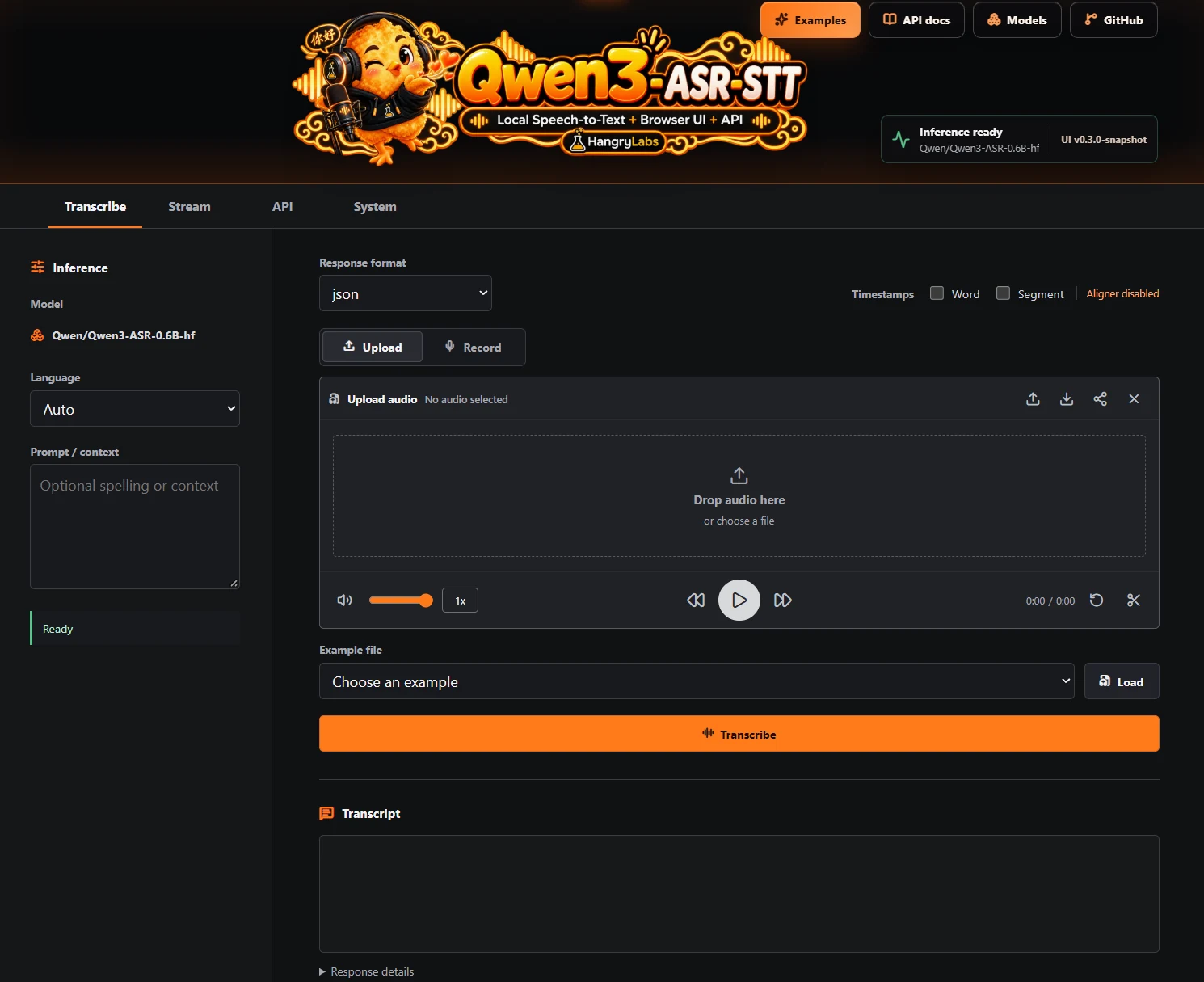
The primary responsive browser UI runs on port 8000 alongside the OpenAI-compatible API. Its HTML, CSS, JavaScript, icons, and WaveSurfer assets are included locally, so the full image remains usable offline after it is pulled.
The header’s Examples link opens the public multilingual showcase in the currently selected interface language. It offers one playable repository test recording and reference transcript for each of the 30 supported transcription languages. Selecting a language filters its recording and automatically localizes the showcase into that language; these broader translations remain self-contained under examples/ rather than expanding the product UI catalogs.
The interface provides four focused views:
- Transcribe: upload or record audio inside a replaceable waveform editor with playback, seeking, volume, speed, trimming, and download controls; load bundled multilingual examples without changing the selected language; choose the response format and inspect the raw response.
- Stream: transcribe the microphone incrementally, finalize or reset a session, choose an input device, and tune the update interval, bounded audio window, and transcript-stability settings with inline explanations.
- API: inspect health, model, language, and inference status from the same service.
- System: inspect readiness plus one-second GPU history for compute load, memory activity, VRAM, temperature, power, fan speed, and graphics/memory clocks. Charts support timestamped hover inspection and switchable one- or ten-minute windows; recent history survives a browser reload. The forced aligner can be loaded, released, or configured to remain loaded across restarts, and realtime defaults can be saved for future UI and API sessions.
The branded header reports the active model, inference readiness, and UI build version. It can collapse into a compact persistent toolbar to leave more room for transcription work. Selecting Word or Segment timestamps loads the forced aligner on demand and keeps it resident for the current container session. The System tab can release that VRAM or persist an always-loaded preference in the mounted settings volume.
The Stream tab uses local realtime transcription sessions backed by repeated inference over a bounded recent-audio window. Once the configurable window is full, older stable transcript tokens are retained outside the model prompt while the overlapping window continues to revise its latest words. This keeps inference cost and model context bounded during long sessions. It is not a full OpenAI Realtime WebSocket implementation.
Remote file upload and API calls work over normal LAN HTTP when the port is exposed. Browser microphone recording requires a secure browser origin, so use localhost or serve the UI over HTTPS when opening it from another machine.
OpenAI-Compatible API
Show API contract, examples, and client usage
The stable integration target is POST /v1/audio/transcriptions. It is exercised with the current OpenAI Python client and can be used by applications that allow a custom OpenAI base URL, including local assistants and automation tools. Interactive OpenAPI documentation is available at http://localhost:8000/docs.
Supported request fields:
| Field | Support |
|---|---|
file |
Required. Tested with aac, flac, mp3, mp4, mpeg, mpga, m4a, ogg, wav, and webm; other formats are passed to the bundled decoder. 100 MB by default. |
model |
Optional. Use qwen3-asr, qwen3-asr-stt, or the active Hugging Face model ID; when omitted, the single loaded model is selected automatically. |
language |
Optional ISO code or language name. Omit it for model-native automatic language identification. |
prompt |
Optional transcription context for vocabulary and style. |
response_format |
json, text, verbose_json, srt, or vtt. |
timestamp_granularities |
word, segment, or both. Requires verbose_json and loads the forced aligner on demand. |
temperature |
Optional, but only 0 is accepted. Both inference backends intentionally use deterministic greedy decoding for stable STT output. |
stream |
Optional. Returns OpenAI-compatible SSE event shapes after completed-file inference; see the realtime distinction below. |
verbose_json always includes the detected language, normalized audio duration, and segments. Without requested alignment, it reports one coarse segment covering the completed audio. With word or segment timestamps, it returns model-estimated forced-alignment timing. srt and vtt automatically request real segment alignment and therefore follow the same aligner language availability rules; they never manufacture placeholder subtitle timings.
For recordings that switch languages, recognition can omit or change words and cause large timestamp errors. See mixed-language transcription and timestamp limits for the confirmed Chinese/Korean case and a tested context workaround.
cURL
curl -X POST "http://localhost:8000/v1/audio/transcriptions" -F "file=@sample.mp3" -F "model=qwen3-asr" -F "response_format=json"
Force a language when you know it:
curl -X POST "http://localhost:8000/v1/audio/transcriptions" -F "file=@sample.mp3" -F "model=qwen3-asr" -F "language=English" -F "response_format=verbose_json"
Request word and segment timestamps:
curl -X POST "http://localhost:8000/v1/audio/transcriptions" -F "file=@sample.mp3" -F "model=qwen3-asr" -F "response_format=verbose_json" -F "timestamp_granularities[]=word" -F "timestamp_granularities[]=segment"
Text response:
curl -X POST "http://localhost:8000/v1/audio/transcriptions" -F "file=@sample.mp3" -F "model=qwen3-asr" -F "response_format=text"
When language is omitted, the service keeps Qwen3-ASR in model-native auto-language mode. The Whisper component in this image is the Qwen audio feature extractor, not a separate language detector that can be enabled or disabled.
Python OpenAI Client
from openai import OpenAI

client = OpenAI(base_url="http://localhost:8000/v1", api_key="local")

with open("sample.mp3", "rb") as audio:
    result = client.audio.transcriptions.create(
        model="qwen3-asr",
        file=audio,
        response_format="json",
    )

print(result.text)
The api_key="local" value satisfies the client constructor; this local server does not validate it. There is no built-in authentication. Treat the service as a trusted local/private-network application, or place an authenticating reverse proxy in front of it. To restrict Docker publishing to the host itself, use -p 127.0.0.1:8000:8000 instead of -p 8000:8000.
MCP
Show MCP documentation and endpoint reference
Both image variants include an opt-in Model Context Protocol server at http://localhost:8000/mcp. Enable MCP connectivity in the System tab on a trusted deployment first. It uses stateless Streamable HTTP in the existing UI/API process, so MCP clients share the already-loaded model, inference queue, upload limit, aligner lifecycle, GPU monitor, settings store, and port. No second model copy or sidecar is started.
Point a Streamable HTTP MCP client at:
http://localhost:8000/mcp
Available tools:
get_healthreports inference readiness and metrics, model and product versions, uptime, forced-aligner state, saved realtime defaults, current GPU telemetry, persistent-storage capacity, supported languages, and the shared file location.transcribe_audio_fileaccepts onefile_location: either a relative/absolute path that resolves inside/app/persistent/mcp-inputby default, or anhttp:///https://file URL. Optional language, prompt/context, and word/segment timestamps are supported.set_aligneraccepts one requiredenabledboolean:trueloads and warms the aligner, whilefalseunloads it and releases its VRAM. It controls only the current in-memory state and does not change the user’s saved Always keep aligner loaded startup preference. The main transcription model remains loaded.configure_realtime_defaultsvalidates and persists the same bounded-window defaults as the System tab.
To make a local file available through the existing persistent volume:
docker cp sample.mp3 qwen3-asr-stt:/app/persistent/mcp-input/sample.mp3
The same tool can then use file_location="sample.mp3". An agent can also pass a file URL returned by another tool, such as file_location="http://tts:8000/generated/example.wav"; Qwen3-ASR STT retrieves the file directly. In both forms, only the small location string enters model context—audio bytes and base64 never do.
Local paths must be visible inside the Qwen3-ASR STT container and remain confined to the configured input directory. Set QWEN_ASR_MCP_INPUT_DIR to another mounted container directory, or to an empty value to disable local-path input while retaining URL input. URL downloads use the same upload-size limit, a 60-second timeout, and at most three redirects; every redirect is validated. Link-local, reserved, multicast, and unspecified destinations and URLs with embedded credentials are rejected. Private and loopback destinations remain available for local Docker and LAN integrations.
QWEN_ASR_MCP_AUDIO_URL_ALLOWED_HOSTS defaults to * for plug-and-play tool chaining. On a shared deployment, restrict it to exact comma-separated TTS hosts such as tts:8000,media.example.test, use *.example.test for a deliberate subdomain wildcard, or set it to an empty value to disable URL input. A URL must be reachable from the ASR container: use a Docker service name, LAN address, or host.docker.internal rather than localhost when the file server runs in another container or on the host.
To measure health discovery, path/URL transcription, runtime controls, and error recovery with a local OpenAI-compatible chat model, use the reusable local AI MCP test. It discovers and exercises the live MCP schemas.
DNS-rebinding protection allows localhost by default. When an MCP client connects through another hostname or IP address, add the exact HTTP Host values as a comma-separated QWEN_ASR_MCP_ALLOWED_HOSTS setting, for example server.example.test:8000. Clients that send an Origin header also need their exact origins in QWEN_ASR_MCP_ALLOWED_ORIGINS. Keep these allowlists narrow; disabling QWEN_ASR_MCP_DNS_REBINDING_PROTECTION is intended only for an already protected private network.
The enable switch prevents accidental MCP exposure. While disabled, the endpoint returns 403 Forbidden to indicate that the deployment owner has not authorized MCP access. This opt-in gate is not an authentication system: like the local UI/API, MCP is intended for a trusted host or private network unless an authenticating reverse proxy is placed in front of it.
File streaming and realtime streaming
These are separate interfaces:
stream=trueon/v1/audio/transcriptionspreserves OpenAI client compatibility for completed files. The server finishes Qwen inference and then sendstranscript.text.deltaandtranscript.text.doneSSE events. It does not reduce time-to-first-text because the underlying file decode returns a completed transcript.- The browser Stream tab uses the Hangry Labs realtime session API. Audio is submitted progressively, inference runs repeatedly over a bounded recent-audio window, and updated text appears while recording continues. This is real progressive streaming, but its HTTP session protocol is a custom extension rather than the OpenAI Realtime WebSocket protocol.
Supported Routes
OpenAI-compatible routes:
GET /v1/modelsGET /v1/models/{model}POST /v1/audio/transcriptions
Hangry Labs discovery and realtime extensions:
GET /v1/audio/supported_languagesPOST /v1/realtime/transcriptions/sessionsPOST /v1/realtime/transcriptions/sessions/{session_id}/audioPOST /v1/realtime/transcriptions/sessions/{session_id}/finishDELETE /v1/realtime/transcriptions/sessions/{session_id}
Operations and system routes:
GET /health(readiness-compatible alias)GET /health/liveGET /health/readyGET /metrics/inferenceGET /system/gpuGET /system/alignerPUT /system/alignerPOST /system/aligner/loadPOST /system/aligner/unloadGET /system/settingsPUT /system/settings/mcpPUT /system/settings/realtime
Protocol endpoint:
POST /mcp(MCP Streamable HTTP; legacy clients may also use the protocol-definedGETandDELETEmethods)
/v1/audio/translations exists as an explicit not-implemented response until Qwen3-ASR translation behavior has a dedicated compatibility pass.
Models
Show model and forced-aligner details
Default full image model:
Qwen/Qwen3-ASR-0.6B-hf
Larger supported ASR model:
Qwen/Qwen3-ASR-1.7B-hf
Optional forced aligner asset:
Qwen/Qwen3-ForcedAligner-0.6B-hf
The forced aligner is not loaded by default. Its first compiled load increased observed VRAM use by approximately 3.3 GiB on an RTX 5070 Ti; releasing it immediately returned about 1.8 GiB, while CUDA/compiler context remained cached until restart. Exact behavior varies by GPU, driver, and runtime settings. Selecting Word or Segment in the browser or requesting timestamp_granularities through the API loads it on demand. The browser forces verbose_json while timestamps are selected and schedules the aligner for release after both options remain unchecked for 60 seconds. The System tab can release it immediately or keep it loaded persistently. To make startup loading the initial default when no saved preference exists, use:
-e QWEN_ASR_ENABLE_ALIGNER=1
The single Qwen aligner supports Chinese, English, Cantonese, French, German, Italian, Japanese, Korean, Portuguese, Russian, and Spanish. It is not a separate model per language; ASR languages outside that list, including Turkish, remain transcribable but cannot produce Qwen forced-alignment timestamps. Japanese alignment includes the required nagisa tokenizer. Korean transcription remains supported, but Korean word/segment alignment is not packaged to avoid adding its GPLv3-only optional tokenizer to the Apache-2.0 image; unsupported or unavailable forced-language requests return an actionable HTTP 422 before loading the aligner.
Runtime Settings
Show runtime settings, persistence, and operations
Every container starts the browser UI and OpenAI-compatible API together on port 8000.
Common environment variables:
| Variable | Default | Purpose |
|---|---|---|
QWEN_ASR_MODEL |
Qwen/Qwen3-ASR-0.6B-hf |
ASR model ID |
QWEN_ASR_BACKEND |
vllm |
Inference backend; transformers is a diagnostic fallback |
QWEN_ASR_ENABLE_ALIGNER |
0 |
Initial always-load default when no saved System preference exists |
QWEN_ASR_SETTINGS_PATH |
/app/persistent/app/settings.json |
Persistent UI/runtime settings file |
QWEN_ASR_ALIGNER_LOAD_TIMEOUT_SECONDS |
600 |
Deadline for an on-demand aligner download/load/warmup |
QWEN_ASR_CONCURRENCY |
2 |
Maximum admitted inference requests (one active engine call plus queue) |
QWEN_ASR_MAX_INFERENCE_BATCH_SIZE |
2 |
ASR inference batch cap |
QWEN_ASR_MAX_NEW_TOKENS |
512 |
Max generated tokens |
QWEN_ASR_MAX_UPLOAD_MB |
100 |
Maximum file or realtime-chunk upload size |
QWEN_ASR_GPU_MEMORY_UTILIZATION |
0.25 |
vLLM GPU-memory reservation fraction |
QWEN_ASR_MAX_MODEL_LEN |
2048 |
vLLM maximum model context |
QWEN_ASR_MAX_NUM_BATCHED_TOKENS |
2048 |
vLLM scheduler token budget |
QWEN_ASR_MAX_NUM_SEQS |
2 |
vLLM scheduler sequence cap |
QWEN_ASR_VLLM_DTYPE |
bfloat16 |
vLLM model dtype |
VLLM_USE_FLASHINFER_SAMPLER |
0 |
Use vLLM’s native sampler and avoid optional FlashInfer sampling-kernel JIT; advanced users may explicitly opt in with 1 |
QWEN_ASR_BACKEND_KWARGS |
unset | JSON object with additional backend loader options |
QWEN_ASR_TRANSFORMERS_DTYPE |
bfloat16 |
Transformers fallback and aligner dtype |
QWEN_ASR_TRANSFORMERS_DEVICE_MAP |
cuda:0 |
Transformers fallback and aligner device |
QWEN_ASR_TORCH_COMPILE |
1 |
Compile Transformers fallback/aligner forwards with PyTorch Inductor |
QWEN_ASR_TORCH_COMPILE_BACKEND |
inductor |
PyTorch compiler backend |
QWEN_ASR_TORCH_COMPILE_MODE |
default |
PyTorch compiler mode |
QWEN_ASR_TORCH_COMPILE_FULLGRAPH |
0 |
Require the entire forward pass to compile as one graph |
QWEN_ASR_STARTUP_WARMUP |
1 |
Run representative decode warmups before the service reports healthy |
QWEN_ASR_STARTUP_WARMUP_TOKENS |
512 |
Token cap used by startup warmup |
QWEN_ASR_STARTUP_WARMUP_ITERATIONS |
3 |
Number of startup decode passes used to compile and stabilize generation |
QWEN_ASR_INFERENCE_TIMEOUT_SECONDS |
120 |
Deadline before readiness fails and the process recycles |
QWEN_ASR_INFERENCE_QUEUE_TIMEOUT_SECONDS |
120 |
Maximum wait for the single engine owner |
QWEN_ASR_REALTIME_SESSION_TTL_SECONDS |
900 |
Idle realtime session expiry |
QWEN_ASR_ENABLE_MCP |
0 |
Initial MCP availability for a new settings volume; the persisted System toggle takes precedence afterward |
QWEN_ASR_MCP_INPUT_DIR |
/app/persistent/mcp-input |
Only directory available to MCP local-path input; empty disables local paths |
QWEN_ASR_MCP_AUDIO_URL_ALLOWED_HOSTS |
* |
Comma-separated URL hosts accepted by file_location; empty disables URL input |
QWEN_ASR_MCP_AUDIO_URL_TIMEOUT_SECONDS |
60 |
Total timeout for an MCP audio URL download |
QWEN_ASR_MCP_AUDIO_URL_MAX_REDIRECTS |
3 |
Maximum redirects followed for an MCP audio URL |
QWEN_ASR_MCP_DNS_REBINDING_PROTECTION |
1 |
Validate MCP Host and Origin headers |
QWEN_ASR_MCP_ALLOWED_HOSTS |
localhost addresses | Comma-separated exact hosts accepted by MCP, with :* supported for any port |
QWEN_ASR_MCP_ALLOWED_ORIGINS |
localhost HTTP/HTTPS origins | Comma-separated origins accepted by MCP |
QWEN_ASR_WATCHDOG_ENABLED |
1 |
Probe auto-language inference before readiness and periodically afterward |
QWEN_ASR_WATCHDOG_INTERVAL_SECONDS |
300 |
Watchdog interval |
QWEN_ASR_WATCHDOG_TIMEOUT_SECONDS |
60 |
Watchdog inference deadline |
QWEN_ASR_SSL_CERTFILE |
unset | HTTPS certificate file path inside the container |
QWEN_ASR_SSL_KEYFILE |
unset | HTTPS private key file path inside the container |
The System tab writes the safe operator-controlled values to /app/persistent/app/settings.json, including MCP availability, forced-aligner residency, and realtime defaults:
{
  "load_aligner_always": false,
  "realtime_defaults": {
    "chunk_size_sec": 2.0,
    "max_window_sec": 30.0,
    "unfixed_chunk_num": 2,
    "unfixed_token_num": 5
  }
}
You may edit this file while the container is stopped. Model selection, backend, GPU allocation, compilation, and health-policy settings remain environment variables because changing them requires a controlled process restart.
Inference is serialized through one owner because the offline vLLM API is synchronous. A timeout or fatal model error changes readiness to HTTP 503 and terminates the process after logging diagnostics. Keep --restart unless-stopped, or equivalent orchestrator supervision, enabled so the model is reloaded automatically. /health/live remains a cheap HTTP liveness check; /health/ready and /health report inference admission state.
For the 1.7B model, increase the memory/context profile:
docker run --name qwen3-asr-stt --restart unless-stopped -p 8000:8000 --gpus all -e CUDA_VISIBLE_DEVICES=0 -e HF_HUB_OFFLINE=1 -e TRANSFORMERS_OFFLINE=1 -e QWEN_ASR_MODEL=Qwen/Qwen3-ASR-1.7B-hf hangrylabs/qwen3-asr-stt:latest
Decoding temperature is intentionally fixed at 0 for deterministic transcription. Do not increase it for normal STT use.
Cache Behavior
The single qwen3_asr_stt_data volume stores downloaded/baked model assets, vLLM and TorchInductor compiler caches, and operator settings under /app/persistent. Reuse the same named volume with later image tags to preserve continuity. It does not preserve loaded GPU weights or live CUDA graph state, so startup profiling and warmup still run. Docker initializes a new named volume from the full image’s baked /app/persistent contents automatically; the tiny image downloads into the same layout on first online use.
If you used the legacy cache/settings volumes, run this once before retiring them to carry their contents into the unified layout without downloading the models again:
docker run --rm --entrypoint sh -v qwen3_asr_stt_hf_cache:/legacy/huggingface:ro -v qwen3_asr_stt_torch_compile_cache:/legacy/torchinductor:ro -v qwen3_asr_stt_vllm_cache:/legacy/vllm:ro -v qwen3_asr_stt_settings:/legacy/settings:ro -v qwen3_asr_stt_data:/app/persistent hangrylabs/qwen3-asr-stt:latest_tiny -c "mkdir -p /app/persistent/models/huggingface /app/persistent/cache/torchinductor /app/persistent/cache/vllm /app/persistent/app && cp -an /legacy/huggingface/. /app/persistent/models/huggingface/ && cp -an /legacy/torchinductor/. /app/persistent/cache/torchinductor/ && cp -an /legacy/vllm/. /app/persistent/cache/vllm/ && cp -an /legacy/settings/. /app/persistent/app/"
The old volumes are left untouched. Remove them only after confirming the new container is healthy.
To use browser microphone recording from another machine, mount a trusted certificate and start the server with HTTPS:
docker run --name qwen3-asr-stt --restart unless-stopped -p 8000:8000 --gpus all -e CUDA_VISIBLE_DEVICES=0 -e QWEN_ASR_SSL_CERTFILE=/certs/fullchain.pem -e QWEN_ASR_SSL_KEYFILE=/certs/privkey.pem -v /absolute/path/to/certs:/certs:ro hangrylabs/qwen3-asr-stt:latest
Local Development
Preview the README-based website and listening gallery with task pages, build
with task pages-build, or check staging and language routing with task pages-test.
See the website guide for prerequisites and configuration.
Show local development and release workflows
This repository uses Taskfile workflows on the development workstation.
The runtime is intentionally split by responsibility: docker_entrypoint.py resolves deployment
configuration, server/application.py assembles and serves the product, server/openai_api.py
owns API behavior, standalone_ui/ owns browser routes and assets, and inference/ contains the
model adapters. The supported application is always the combined Docker UI/API service.
Build the full image:
task image
Build the tiny image:
task image-tiny
Run the full image:
task imagerun
task imageweb
Run with local source bind-mounted for UI/API development:
task localrun
task logs
Preview the static examples website from the repository root:
python -m http.server 8011
Then open http://localhost:8011/examples/. The examples site is self-contained and can also be opened directly through examples/index.html; the local server is recommended because it matches GitHub Pages behavior and produces a normal HTTP origin.
Run benchmark model profiles:
task deploy-api-17b
task deploy-api-06b
Regenerate locked Linux/Python 3.13 dependencies:
task deps
Preview and run a release from a clean, synchronized main branch:
task release DRY_RUN=1
task release
The release task requires a snapshot VERSION such as 1.0-snapshot, validates package metadata, Python compilation, CodeQL results, and Dockerfile structure, and converts it into the annotated v1.0 release tag. It then prepares the next minor snapshot and README history section before atomically pushing main and the release tag to origin. GitHub Actions publishes identical full and tiny images to Docker Hub and GHCR. Creating the public GitHub Release entry remains an intentional manual step: first deploy and validate the immutable version tag, then publish its release entry. This preserves the option to correct a tag before making the irreversible public release announcement. Pass an explicit newer NEXT_VERSION=X.Y-snapshot to override the default next-minor snapshot, or use SKIP_VALIDATION=1 only when the same release commit has already passed the lightweight validation sequence. Test the existing rolling image separately before release when dependency-backed or runtime verification is required.
Stop containers:
task imagestop
Benchmarks
Show benchmark documentation and commands
Public benchmark notes live in:
benchmarks/vram/model_vram.mdbenchmarks/transcription/BENCHMARKS.mdbenchmarks/transcription/DETAILS.mdbenchmarks/robustness/BENCHMARKS.mdbenchmarks/robustness/DETAILS.md
The transcription benchmark corpus uses 30 Qwen3-ASR-supported languages with 10 random examples per language. Official benchmark tasks run mandatory prewarm requests and discard prewarm timing before recording measured results.
Run benchmarks against the matching API deployment:
task benchmark-transcription-17b
task benchmark-transcription-06b
The benchmark scores focus on transcription meaning. Punctuation, quote recovery, and expressive marks are counted as bonus signal rather than required exact text.
Version History
Snapshot commands intentionally follow the rolling latest tags. Published-release commands retain their readable version tag and also pin Docker Hub’s immutable top-level OCI index digest; the digest is authoritative if a tag is ever changed.
v1.1 Snapshot
-
Updated dnspython to 2.9.2 for CVE-2026-128089, which fixes excessive memory/CPU consumption when parsing malicious WKS zone records. Raised the dependency floor to prevent vulnerable versions from returning during lock regeneration.
-
Documented the confirmed Chinese/Korean recognition and timestamp limitation from QwenLM/Qwen3-ASR#221, including a bounded context workaround. This remains an open model-quality issue; inference defaults are unchanged.
-
Updated the inference dependency stack to vLLM 0.32, PyTorch 2.13/CUDA 13.0, and Transformers 5.19, with patched Pillow, aiohttp, certifi, dnspython, filelock, and OpenTelemetry dependencies. Removed the unused remote-theme ZIP loader from the local website builder. See the dependency security review for remaining upstream constraints.
-
Add a multilingual README-based project website with shared navigation, an integrated 30-language listening gallery, and scoped RTL support.
- Added an opt-in MCP Streamable HTTP endpoint to both Docker variants without loading another model. Its single
transcribe_audio_file(file_location=...)tool accepts either a confined local path or a bounded HTTP(S) file URL, while structured health and control tools expose inference/GPU state, forced-aligner lifecycle, and persistent realtime defaults. It reuses the REST API’s inference and alignment boundary, enforces the same 100 MB limit, retains DNS-rebinding protection, and creates the input directory for existing persistent volumes. - Added a repeatable local-chat-model MCP tool-use benchmark covering health discovery, path/URL transcription, argument accuracy, timestamps, runtime controls, security errors, and retry recovery with Qwen 3.6 35B-A3B Q4_K_M.
- Disabled the optional FlashInfer top-k/top-p sampler by default in favor of vLLM’s native sampler. Qwen3-ASR uses deterministic decoding, while FlashInfer’s startup JIT could terminate otherwise healthy GPU deployments when NAS or container runtimes exposed
libcuda.so.1without the unversionedlibcuda.solinker name. Advanced users can still opt in withVLLM_USE_FLASHINFER_SAMPLER=1.
The current development snapshot is published through the rolling tags from main:
Standard image
docker run --name qwen3-asr-stt --restart unless-stopped -p 8000:8000 --gpus all -v qwen3_asr_stt_data:/app/persistent hangrylabs/qwen3-asr-stt:latest
Tiny image
docker run --name qwen3-asr-stt-tiny --restart unless-stopped -p 8000:8000 --gpus all -e HF_HUB_OFFLINE=0 -e TRANSFORMERS_OFFLINE=0 -v qwen3_asr_stt_data:/app/persistent hangrylabs/qwen3-asr-stt:latest_tiny
v1.0
Show v1.0 release notes and deployment commands
- Hardened the public API contract for OpenAI-client integrations while retaining its convenient permissive behavior: documented multipart and realtime schemas in
/docs, made the single loaded model optional to specify, added model registration timestamps, completed unalignedverbose_jsonmetadata, made SRT/VTT use real forced alignment, enforced timestamp-format rules, added tested AAC support and a configurable 100 MB upload limit, normalized unexpected failures, grouped custom and compatible routes, and added a live OpenAI Python client contract regression. - Added persistent and on-demand forced-aligner lifecycle management. Word or Segment selection can load the aligner without restarting, while the System tab can release its VRAM or keep it loaded across container replacements through the unified product data volume. Segment output is now divided into punctuation-, silence-, and duration-aware cues instead of one whole-file block.
- Added Japanese word/segment alignment support to the image, capability-aware timestamp language validation, automatic idle aligner release, forced
verbose_jsontimestamp output, actionable language-tokenizer errors, persistent realtime defaults, and one unified data volume for model assets, compiler caches, and application settings across releases. - Added a viewport-bounded Qwen3-ASR-STT brand hero that collapses into a responsive persistent header, restores its state before first paint, keeps the full loaded model available as hover detail, and links the displayed UI version to GitHub Releases. Refreshed the WebP Hangry Labs artwork across the UI, examples, and 404 page; added a localized, linked “Powered by Hangry Labs” signature; and placed the Hangry Labs logo immediately left of the Qwen mascot in the compact header. Reduced the vendored Lucide font to the glyphs used by the workspace.
- Refined microphone workflows with automatic example loading, single-button record/stop controls for both recorded and realtime audio, responsive recording waveforms, aligned device refresh controls, and clearer recording status placement.
- Expanded the System-tab GPU monitor with one-second tracking charts for compute load, memory activity, VRAM, temperature, power, fan speed, and graphics/memory clocks. Added timestamped hover values, one- and ten-minute windows, on-demand server sampling, and browser-session history restoration. The System layout now keeps operational controls in the narrower left column while the wider GPU monitor remains at the top right.
- Extended transcription benchmarks with detected GPU identity, end-to-end request latency, audio duration, real-time factor, and realtime throughput. The refreshed 0.6B run processed 1,320.936 seconds of audio in 32.376 seconds on an RTX 5070 Ti, or 40.80 times realtime, while scoring 96.10% plus a 0.41% bonus.
- Reorganized runtime composition into a dedicated product application layer, limited the browser and API modules to their own responsibilities, colocated GPU telemetry with the UI, removed the obsolete API-only launcher and direct-library input/export compatibility paths, and pruned seven unused packages from the locked Docker dependency set.
- Polished forced-alignment workflows with timestamp choice restoration during ordinary page refreshes, automatic removal of incompatible examples, live load-completion feedback, tokenizer preloading, and dynamic-shape compilation to avoid first-use recompilation when audio or alignment language changes.
- Replaced quadratic forced-aligner timestamp repair with a stable O(N log N) implementation based on upstream PR QwenLM/Qwen3-ASR#215, preserving existing anchors and interpolation results.
- Reproduced zero-duration lexical timestamps from QwenLM/Qwen3-ASR#197 and added a model-score-aware constrained decoder fallback that preserves ordinary alignment output while resolving affected words into positive, monotonic spans.
- Profiled the cumulative realtime path from QwenLM/Qwen3-ASR#199, reproduced 4.8x latency growth and a 74-second model-context failure, and replaced unbounded accumulation with a configurable stable rolling audio/transcript window. A 120-second regression now completes with a 30-second inference cap and stable post-window update latency.
- Added a deterministic 44-case audio robustness benchmark for QwenLM/Qwen3-ASR#165, covering silence, synthetic noise, hum, echo, and weak speech in automatic and forced-language modes. The 0.6B baseline produced no false positives for 10 automatic-language non-speech cases but hallucinated text for 18 of 20 forced-language cases; clean speech remained accurate at 1% amplitude. The runtime intentionally preserves model-native silence handling instead of adding VAD or energy gating that could alter streaming, alignment, quiet-speech, or training-data workflows.
- Reproduced the prompt/context leakage reported in QwenLM/Qwen3-ASR#186: forced-language decoding can copy context when audio is silent or weak, while real speech can anchor the same context as a useful vocabulary hint. This upstream model behavior remains unchanged rather than adding lossy prompt filtering or a separate hotword model.
- Added GitHub Container Registry as an official image mirror. One workflow publishes identical full and tiny rolling and immutable tags to Docker Hub and GHCR.
- Unified full and tiny publishing in one Buildx job so both variants reuse the same dependency graph without loading either image into the runner’s Docker store. Model prefetch now depends only on its focused downloader code and build arguments, and baked assets occupy an independent final-image layer, allowing unrelated UI/API changes to reuse both the downloads and the large model layer.
- Added complete browser UI localization for English, Polish, Japanese, Chinese, Spanish, and German. Official locale routes (
/en,/pl,/ja,/zh,/es, and/de) provide stable guide links, while the root page defaults to English and remembers each browser’s selected language. - Added a responsive, dependency-free GitHub Pages showcase with playable repository audio, reference transcripts, native-language filters, and self-contained localization for all 30 supported transcription languages. Selecting a language now filters its recording and localizes the page automatically, while the browser UI links to the matching language directly.
- Made public Docker and API commands single-line for direct use in Bash, PowerShell, and Windows Command Prompt, documented the provenance of generated audio fixtures, and kept GitHub Release publication as an explicit manual gate after tagged deployment validation.
- Added concise GitHub README summaries in Norwegian Bokmål, Polish, Japanese, Simplified Chinese, and Spanish, with a language switcher below the project logo and locale-matched links to the complete Hangry Labs product guides.
Run this release with either image variant:
Standard image
docker run --name qwen3-asr-stt-v1-0 --restart unless-stopped -p 8000:8000 --gpus all -v qwen3_asr_stt_data:/app/persistent hangrylabs/qwen3-asr-stt:v1.0@sha256:ea222327b6e999803715abdded7f714a689c54f83a30addbce30e83d163c4527
Tiny image
docker run --name qwen3-asr-stt-v1-0-tiny --restart unless-stopped -p 8000:8000 --gpus all -e HF_HUB_OFFLINE=0 -e TRANSFORMERS_OFFLINE=0 -v qwen3_asr_stt_data:/app/persistent hangrylabs/qwen3-asr-stt:v1.0_tiny@sha256:92fe5ffec58b53c068895c94bfe407201cad2aa0f577ca03e842d9efb69257b7
v0.2.0
Show v0.2.0 release notes and deployment commands
- Synchronized the maintained Hangry Labs runtime with upstream Qwen3-ASR through upstream commit
7c6daf7. - Migrated the runtime to the upstream Hugging Face Qwen3-ASR and forced-aligner implementations.
- Replaced the legacy checkpoints with
Qwen3-ASR-0.6B-hf,Qwen3-ASR-1.7B-hf, andQwen3-ForcedAligner-0.6B-hfin the offline image. - Replaced the deleted custom vLLM model/plugin with vLLM 0.26’s maintained built-in Qwen3-ASR implementation and made it the production default.
- Corrected a major migration regression where production inference had temporarily fallen back to native Transformers instead of the optimized graph-backed vLLM path.
- Upgraded and locked PyTorch 2.11 CUDA 13.0, Transformers 5.14, and vLLM 0.26, including a compiler/runtime compatibility pin for FlashInfer JIT builds.
- Restored full-and-piecewise CUDA graph execution, FlashInfer kernels, deterministic decoding, representative auto/forced-language warmups, and persistent vLLM, FlashInfer, and TorchInductor caches.
- Reduced the 0.6B 300-file transcription benchmark from 277.136 seconds on the initial v0.2 native Transformers path to 31.497 seconds on the integrated vLLM path. This is 43% faster than the historical v0.1 result of 55.382 seconds while maintaining comparable quality at 96.05 versus 95.99.
- Preserved realtime decoding, optional native forced alignment, serialized inference, readiness, watchdog, and process-recovery safeguards.
- Replaced the previous Gradio interface with a responsive local browser UI on the main port 8000, removing the second UI listener and Gradio runtime dependency.
- Added the branded model/readiness/version header, replaceable waveform upload and recording editors, playback and trimming tools, multilingual examples, direct aligner capability feedback, realtime-setting explanations, API status, and GPU visibility.
- Vendored Lucide and WaveSurfer assets for offline UI use and preserved their licenses in the distribution and third-party notices.
- Removed the legacy
qwen_asr.server.appmodule and direct-library example scripts so the supported product surface is the Docker-first standalone UI and OpenAI-compatible API.
Run this release with either image variant:
Standard image
docker run --name qwen3-asr-stt-v0-2-0 --restart unless-stopped -p 8000:8000 --gpus all hangrylabs/qwen3-asr-stt:v0.2.0@sha256:3b04e64ef9a516b879b8829dc142ad0b192adb371cc2162e610ea5c6da2eb7e3
Tiny image
docker run --name qwen3-asr-stt-v0-2-0-tiny --restart unless-stopped -p 8000:8000 --gpus all -e HF_HUB_OFFLINE=0 -e TRANSFORMERS_OFFLINE=0 -v qwen3_asr_stt_v0_2_0_hf_cache:/app/.cache/huggingface hangrylabs/qwen3-asr-stt:v0.2.0_tiny@sha256:2facd0a2b4396ce656c38773bed7dba1d2ad6c401d2881ff39c0a81a83333524
v0.1.0
Show v0.1.0 release notes and deployment commands
- Forked Qwen3-ASR into a Hangry Labs runtime-focused project for local and private speech-to-text inference.
- Added a Python 3.13 runtime with pinned dependencies and reproducible full and tiny Docker image targets.
- Added a full offline-capable image with the Qwen3-ASR 0.6B and 1.7B models plus the optional forced-aligner asset baked into the image and validated during builds.
- Added a tiny image for smaller deployments that download models into a persistent Hugging Face cache volume.
- Made Qwen3-ASR 0.6B the default model while retaining configurable 1.7B support and model-specific GPU/context profiles.
- Added persistent vLLM/Torch compile caching, startup warmup, deterministic decoding, bounded generation, and offline runtime defaults.
- Added a combined FastAPI and Gradio service that exposes the browser UI and APIs from one container and port.
- Added a browser UI for file upload, microphone recording, bundled examples, language selection, realtime transcription, API status, response inspection, and GPU monitoring.
- Added the OpenAI-compatible
/v1/audio/transcriptionsAPI with JSON, verbose JSON, and text responses, automatic or forced language selection, model discovery, and supported-language routes. - Added local realtime transcription session APIs and UI streaming with buffered appends, incremental results, finalization, deletion, and abandoned-session cleanup.
- Added optional forced alignment for timestamped transcription responses without loading the aligner into VRAM by default.
- Added HTTPS certificate and key configuration so browser microphone capture can work from secure remote origins.
- Serialized access to the synchronous offline vLLM engine to prevent unsafe overlapping inference across API, realtime, UI, warmup, and watchdog operations.
- Added inference and queue deadlines, degraded readiness state, diagnostic logging, and supervised process recycling when an engine call cannot be recovered safely.
- Added separate liveness and readiness endpoints, inference metrics, startup readiness probes, and a periodic auto-language inference watchdog.
- Added 0.6B and 1.7B VRAM and multilingual transcription benchmark workflows with mandatory prewarming and a 300-file, 30-language test corpus.
- Added Taskfile workflows for dependency locking, image builds, local deployments, model-specific benchmarks, API checks, logs, cleanup, CodeQL analysis, and guarded releases.
- Added GitHub Actions for lightweight source and packaging checks plus full/tiny Docker image publication with rolling and immutable release tags.
- Removed upstream training, fine-tuning, and dataset-preparation surfaces to keep the fork focused on inference, Docker deployment, API compatibility, UI testing, and operational reliability.
Run this release with either image variant:
Standard image
docker run --name qwen3-asr-stt-v0-1-0 --restart unless-stopped -p 8000:8000 --gpus all hangrylabs/qwen3-asr-stt:v0.1.0@sha256:da0ce7034fe162989e8c23bc6b28ccab40eda32708893eff203bb22532742916
Tiny image
docker run --name qwen3-asr-stt-v0-1-0-tiny --restart unless-stopped -p 8000:8000 --gpus all -e HF_HUB_OFFLINE=0 -e TRANSFORMERS_OFFLINE=0 -v qwen3_asr_stt_v0_1_0_hf_cache:/app/.cache/huggingface hangrylabs/qwen3-asr-stt:v0.1.0_tiny@sha256:0274e0b2cfcbb5595f24fccec5b0dcbbdfc8e3baf2ba66c737154d843a73f3fe
Responsible Use and Privacy
Speech recordings and transcripts can contain personal or sensitive information. This project is designed so you can run ASR locally or inside your own infrastructure instead of sending audio to a third-party hosted API.
You are responsible for obtaining consent where required and for complying with applicable laws, regulations, workplace policies, and platform rules. Do not use this project for covert recording, surveillance, harassment, fraud, or other illegal or unethical activity.
About Qwen3-ASR
Qwen3-ASR is an upstream Qwen speech recognition model family with:
Qwen/Qwen3-ASR-1.7B-hfQwen/Qwen3-ASR-0.6B-hfQwen/Qwen3-ForcedAligner-0.6B-hf
The ASR models support language identification and speech recognition for 30 languages plus Chinese dialect/accent categories. The forced aligner supports timestamp alignment for selected languages.
Upstream links:
- Qwen3-ASR repository: https://github.com/QwenLM/Qwen3-ASR
- Hugging Face collection: https://huggingface.co/collections/Qwen/qwen3-asr
- Qwen3-ASR blog: https://qwen.ai/blog?id=qwen3asr
- Qwen3-ASR paper: https://arxiv.org/abs/2601.21337
This repository preserves upstream attribution and license while focusing on Hangry Labs Docker packaging, local UI/API integration, benchmarking, and release tooling.
License
This project is released under the Apache-2.0 license. See LICENSE.
The standalone browser UI includes permissively licensed third-party assets;
see THIRD_PARTY_NOTICES.md for attribution and the
locations of their complete license texts.
Citation
If you use Qwen3-ASR in research, cite the upstream Qwen3-ASR paper. Use the canonical citation from the upstream repository or paper page:
https://arxiv.org/abs/2601.21337